


In the hills of Nepal, villages and towns have depended on natural springs for generations. But a quiet crisis has been unfolding for years; they are drying up or becoming unreliable. Changing rainfall patterns, warming temperatures, and heavier land use without restoration are all part of the story (Ojha et al., 2019; Gautam & Joshi, 2021). This problem has been tackled differently in Dhulikhel, a town 28km away from Kathmandu. The response to the crisis offers a hopeful lesson - one that isn't really about huge infrastructure or technology, but day-to-day activity about what people say.
That response is Pani Chautari. Pani Chautari, developed by the Southasia Institute of Advanced Studies (SIAS), demonstrates how bringing an organization's research capacity together with indigenous knowledge and local authority can unlock solutions that no single group could reach on its own (CDKN, 2022).
What is Pani chautari?
To understand what Pani chautari is, you will need to understand what a chautari has always been. If you walk any old trail in rural Nepal, you will come across a stone platform built around the base of a tree (commonly pipal or banyan). These stone platforms not only provide shade and a resting place for travellers but also serve as communal spaces for exchanging news and discussing matters.
Someone at SIAS had a simple idea: what if the platform was introduced but for water?.
Not a one-day stakeholder consultation that produces a report that nobody reads, but a returning place where people could come again and again, argue, learn, and slowly build long-lasting trust (CDKN, 2022).
According to SIAS, Pani Chautari is a process for articulating and implementing policy that fosters evidence-informed dialogue on all aspects of water policy and practice to address city-level water problems (Devkota et al., 2020). Technically, elaborating on its definition and scope involves an interactive process, as outlined below.
Pani Chautari Process:
Local water users, municipal officials, private water suppliers, and SIAS's researchers meet regularly to work through a shared process which consists of:
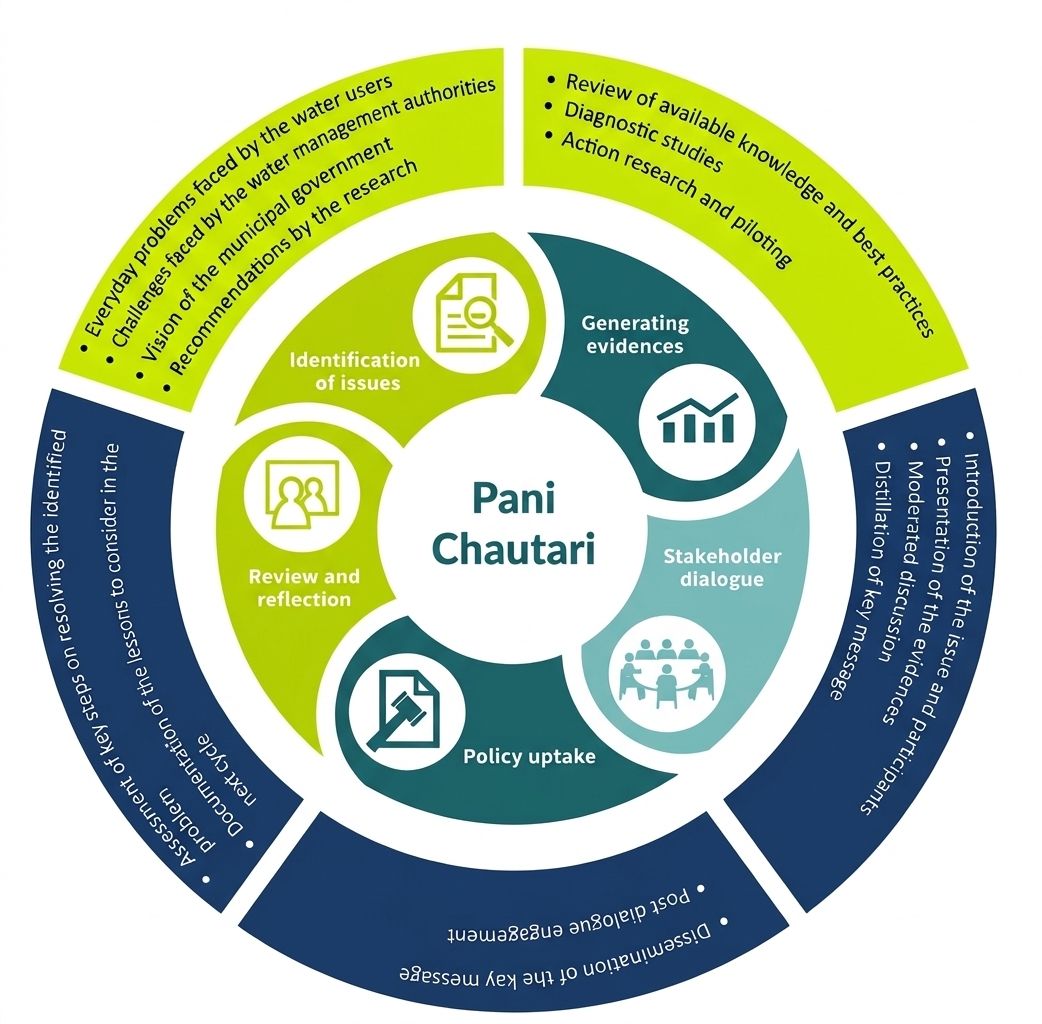
Identification of issues
The process starts with the identification of problems related to water to be discussed in Pani Chautari. Problems were identified from water users, water management bodies, local government priorities, and research conducted by the SIAS team (CDKN, 2022). In Dhulikhel, minimum female representation in discussions was seen, so a specific Pani Chautari dedicated to gender issues and the role of women in water management was conducted (CDKN, 2022).
Generating evidence
The second step is where the evidence is generated for the identified issues. The evidence is generated through literature review, study of policy and practices, and action research or quick experiments (CDKN, 2022). One analysis of climate data was conducted over the past four decades, which showed a decline in the average rainfall in the region (Ojha et al., 2019). The changes in average rainfall patterns and stream flows were considered one of the factors in the drying up of the local spring sources (Gautam & Joshi, 2021).
Stakeholder dialogue
The stakeholder dialogue brings scattered stakeholders into a single platform, Pani Chautari, to discuss the identified problems and possible solutions. The stakeholders were introduced to issues, and the evidence was presented. Participatory approaches such as visual materials, presenting in the local language, and adaptation of different formats for discussion were used by the SIAS team (CDKN, 2022).
Policy uptake
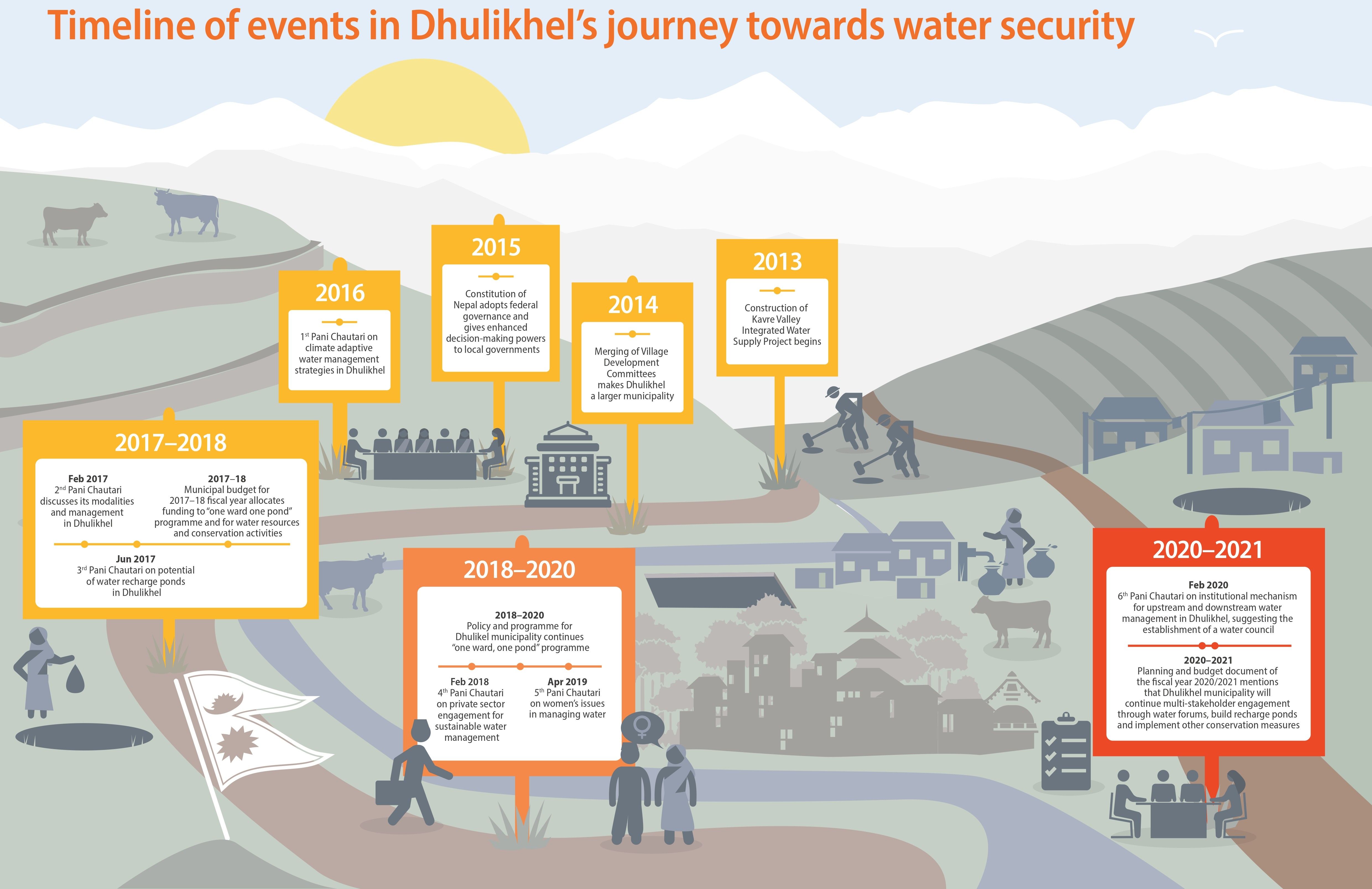
The policy uptake required dissemination of the key outcomes through local media, press releases, opinion writing, etc. Follow-up meetings among key stakeholders for action-oriented solutions were conducted (CDKN, 2022). For example, the 6th Pani Chautari conducted in February 2020 led to the formation of a water council with representation from disputing upstream and downstream communities and other stakeholders to ensure cooperative and sustainable water management (CDKN, 2022).
Review and Reflection
The review and reflection stage consists of a multi-stakeholder dialogue where the cycle is reviewed to assess how the different steps contribute to solving the identified problem (Devkota et al., 2020). This process enables us to find the strengths and weaknesses to be considered in the next cycle (Devkota et al., 2020).
Results of Pani Chautari:
Three types of recharge ponds were created: evacuated ponds, embankment ponds, and contour trenches. 64 such small-scale ponds varying in size, ranging from 3.45 m³ to 35.69 m³, were constructed in two phases on the terraces of the Dhulikhel hills (Shrestha et al., 2021). Monitoring of ten selected springs from May 2017 to January 2020 showed the yearly peak discharge increased from 6.4 liters per second (lps) in 2017 to 7.3 lps in 2018 to 9.0 lps in 2019—an increase of roughly 40% over the three years (Shrestha et al., 2021). Due to this demonstrative effectiveness of the recharge ponds and trenches in increasing spring water discharge, the "One Ward, One Pond Programme" was incorporated in the fiscal year plan 2017/18 (CDKN, 2022).
Pani Chautari has been implemented in many other municipalities, like Dhulikhel, Dharan, and Bidur, in Nepal (Devkota et al., 2020). In Dharan, it led to mandatory recharge pits for new construction, addressing both groundwater depletion and stormwater runoff, while also building a community of practice around urban water security among researchers, officials, and residents (Devkota et al., 2020).
These outcomes show that Pani Chautari is not limited to water. Its real value lies in the process itself, evidence generation, stakeholder dialogue, and policy uptake, rather than any single technical fix. This same cycle could be applied to sectors like waste management, urban planning, or public health, wherever local governments need to turn evidence and community input into lasting policy. In that sense, Pani Chautari offers Nepal's municipalities a reusable model for evidence-based governance, not just a solution to a water crisis.
References
CDKN (2022). Collaborative urban water management bridges knowledge and action in Nepal. Knowledge for Change series: Lessons from Nepal. Climate and Development Knowledge Network.
Devkota, K., Khatri, D., Neupane, K., Upadhyaya, R., Shrestha, S. and Ojha, H. (2020). Pani Chautari guidebook: A facilitation guidebook for evidence-informed dialogue on urban water issues. Kathmandu: SIAS. Retrieved from: https://www.sias-southasia.org/wp-content/uploads/2021/03/Pani-Chautari-Guidebook.pdf
Devkota, K., Maskey, G. and Khatri, D. (2021). 'Pani Chautari as a tool for evidence-informed policy and practice: Experiences from Dhulikhel'. In Dhulikhel's journey towards water security: Insights for policy and practice (pp. 125-141). SIAS and Dhulikhel municipality.
ICLEI South Asia (2022). Fernandes, R., Panwar, V. and Sen, M. Nature-based Solutions for urban climate resilience in South Asia: Cases from Bangladesh, India and Nepal.
Gautam, A. and Joshi, T. (2021). 'Future climate stress on drinking water of Kavre Valley: Case of Upper Roshi River'. In Dhulikhel's journey towards water security: Insights for policy and practice (pp. 104-124). SIAS and Dhulikhel municipality.
Ojha, H., Kovacs, E., Devkota, K., Neupane, K.R., Dahal, N. and Vira, B. (2019). 'Local experts as the champions of water security in the Nepalese town of Dhulikhel'. New Angle: Nepal Journal of Social Science and Public Policy, 5(1), 1-14.
Shrestha, S., Devkota, K., Dahal, N. and Neupane, K. (2021). 'Application of recharge ponds for water management: Explaining from nature-based solution perspective'. In Dhulikhel's journey towards water security: Insights for policy and practice (pp. 142-163). SIAS and Dhulikhel municipality.